
Let’s talk about marketing and sales. No one wants to, but we must. Because if people don’t know what you offer, they can’t buy from you, even if they’d want to.
For most founders I work with, the discomfort shows up in two ways. First, asking someone to take action (sign up, buy, book a call) feels braggy, pushy or inauthentic.
And second, the part of you that wants steady work is quietly panicking that you need to be everywhere, or you're frozen and don't know where to start.
Before I get into, know that marketing and sales will likely feel like a scary stretch. Also know that it shouldn't feel pushy or icky.
This goal of this primer is to help you spend your limited time where it will actually move the needle towards your goal. If you have five hours a week for marketing, I want you to use them in the most effective way possible.
We’ll cover:
- The difference between marketing and sales
- How the funnel works, and what your job is at each stage
- How to read your conversion percentages so you know where to focus
Marketing and sales are not the same thing
People conflate them constantly, and it can create a lot of frustration.
Marketing is how people find you, understand what you do, and start to trust you. It speaks to many people at once and warms them up over time.
Sales is what happens when someone is already interested. It's about helping them make a decision (ideally a "yes).
If you’re not getting enough inquiries, that’s a marketing problem. If you’re getting inquiries but they’re not converting, that’s a sales problem. You need to know the difference because They need different activities and different responses.
Practical tip: Think about your five most recent marketing activities. Were they actually marketing, or were they sales? Most people realize they’ve been conflating the two, and it explains a lot about where the effort is going.
The marketing funnel: awareness, consideration, conversion
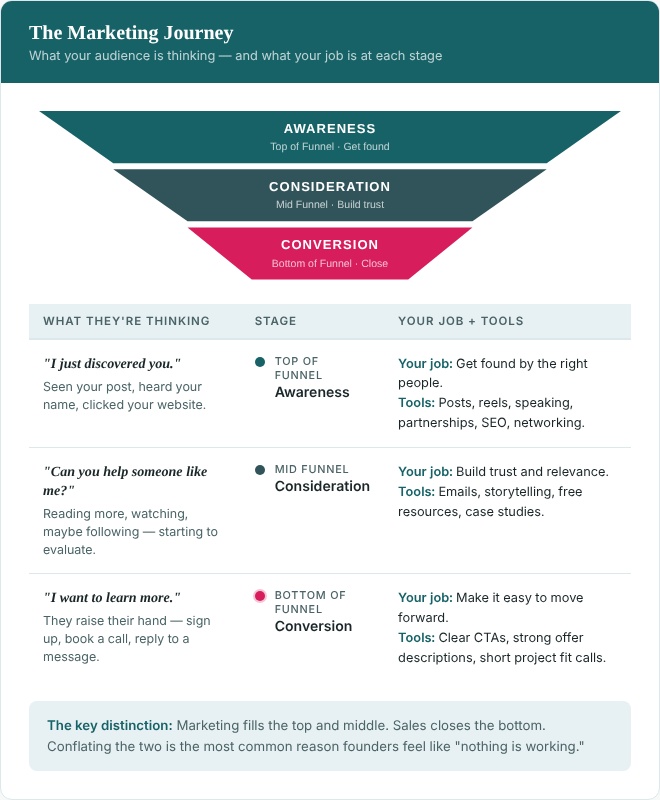
The funnel maps the journey someone takes from first hearing about you to actually working with you everything before the sale.
Awareness. People find out you exist. They see a post, land on your website, hear your name. Your job: get in front of the right people consistently.
Consideration. People are curious and starting to evaluate. They’re reading more, maybe following you, figuring out if you’re the right fit. Your job: build trust and show you understand their situation.
Conversion. Someone raises their hand. They book a call, reply to an email, fill out a form. Your job: make that next step as easy as possible.
A real example: A client of mine, just starting out as a consultant, was creating strong educational content on LinkedIn. Great engagement with likes, comments, shares. But she didn't any client inquiries from it.
Her content was doing exactly what it should: building awareness and credibility. What it wasn’t doing was inviting anyone to take a next step. She wasn't telling people how to get in touch with her, or exactly the problems she was solving.
Without that, people stayed in the “interested but not buying” zone. Once she added a clear call to action, a free call invitation, and some client success stories, that changed.
Practical tip: Map your current marketing activities to a funnel stage. Most people find they’re over-invested in awareness and have almost nothing at consideration or conversion. That’s usually where the gap is.
Know your conversion percentages
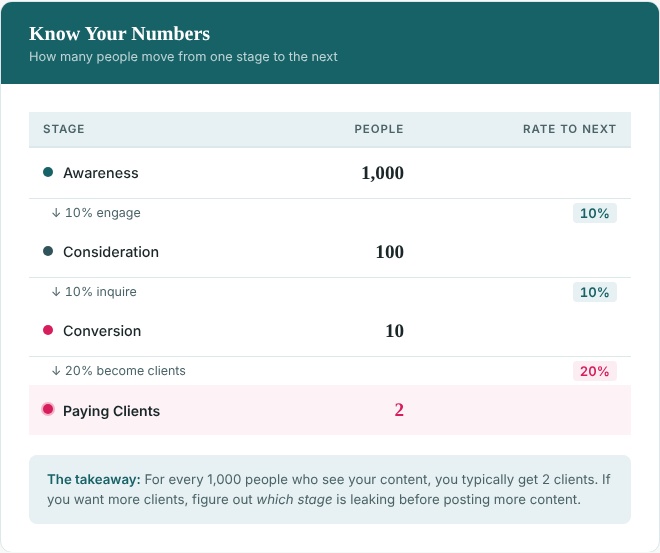
Once your funnel is mapped out, track your conversion percentages, or how many people actually move from one stage to the next.
This matters because if you don’t know your numbers, you might feel like your marketing “isn’t working” when, in reality, you’re just missing a key step.
Imagine:
- 1,000 people see your content (awareness)
- 100 engage meaningfully (newsletter sign-ups, consistent comments, event attendance). (consideration)
- 10 inquire about working with you. (conversion)
- 2 become paying clients. (sales - decision and close).
That’s a 10% rate from awareness to consideration, 10% from consideration to conversion, and 20% from conversion to a paying client. For every 1,000 people who see your content, you get roughly 2 clients.
What to do with that:
- Low awareness-to-consideration rate → your content isn’t resonating, or you’re reaching the wrong people
- Low consideration-to-conversion rate → you need a clearer call to action
- Low conversion-to-sales rate → the issue is in your follow-up or sales conversations
Tracking these numbers removes the guesswork and tells you exactly where to focus.
Selling should feel good
You built this business because you believe what you offer helps people. Marketing and sales, done right, are just the process of making sure the people who need that help can find you and say yes.
If it still feels uncomfortable, try this exercise (link to inner boardroom). Sometimes the discomfort is a signal that something needs to change.
Want more? Part 2 is coming soon. Or watch the full explainer here.
This is Part 1 of a two-part series on marketing fundamentals. Part 2 covers channels: which ones serve which stage of the funnel, and how to choose where to spend your time.


Responses